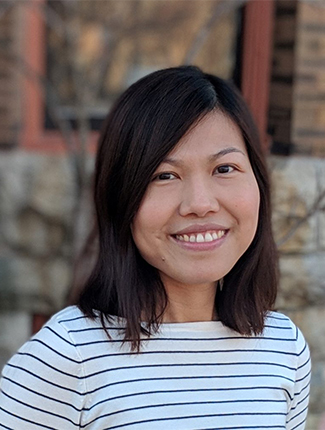
Tu-Anh Huynh
Food Science Department
C-di-AMP signaling in bacterial physiology and pathogenesis
127B Babcock Hall
1605 Linden Dr.
Madison, WI 53706
LAB WEBSITE:
FOCUS GROUPS:
Cellular & Molecular Metabolism; Immunology; Physiology
RESEARCH DESCRIPTION:
My research program investigates signaling mechanisms that mediate bacterial pathogenesis and adaptation. We currently focus on c-di-AMP, which is required for bacterial growth and infection. Within bacteria, c-di-AMP also regulates many cellular processes, such as central metabolism, turgor pressure maintenance, DNA damage repair, and biofilm formation. C-di-AMP is absent in eukaryotes, and bacteria-derived c-di-AMP triggers robust immune responses during infection of the host. Additionally, the accumulation of c-di-AMP is also toxic to bacterial virulence. Employing the human pathogen Listeria monocytogenes as a model, we’re pursuing the following aspects of c-di-AMP signaling: i) What are the biological functions of c-di-AMP binding proteins in bacteria and infected host cells? ii) What are the mechanisms by which c-di-AMP regulates its protein targets? iii) High-throughput screens for inhibitors of c-di-AMP hydrolysis for use as antibiotics or antibiotic adjuvants. We’re also beginning to investigate the essential roles of c-di-AMP in Bacteroides the taiotaomicron, a human commensal bacterium.
ALSO A TRAINER IN THE FOLLOWING PROGRAMS:
Microbiology Doctoral Training Program (MDTP), Comparative Biomedical Sciences (CBMS), Food Science